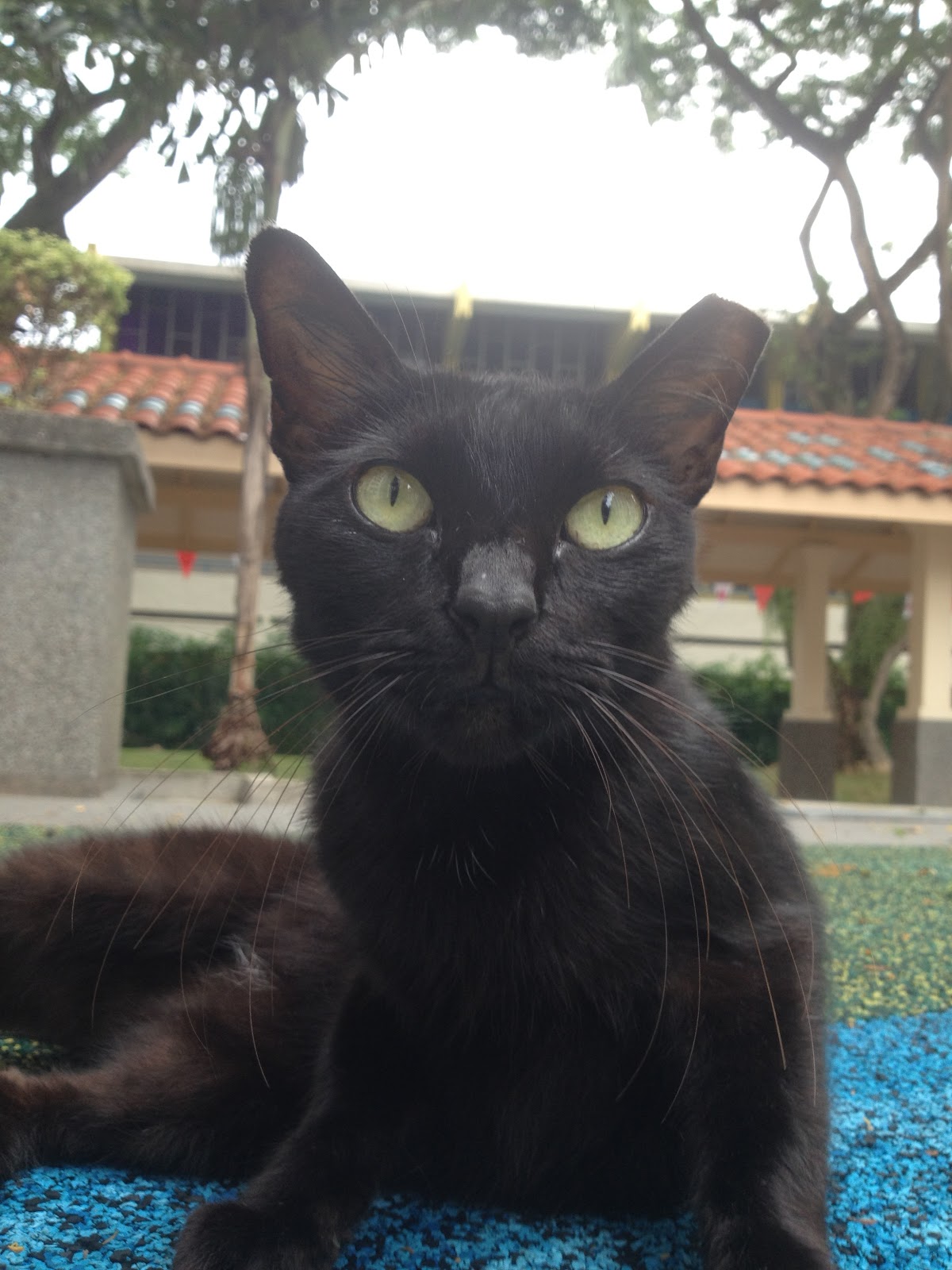
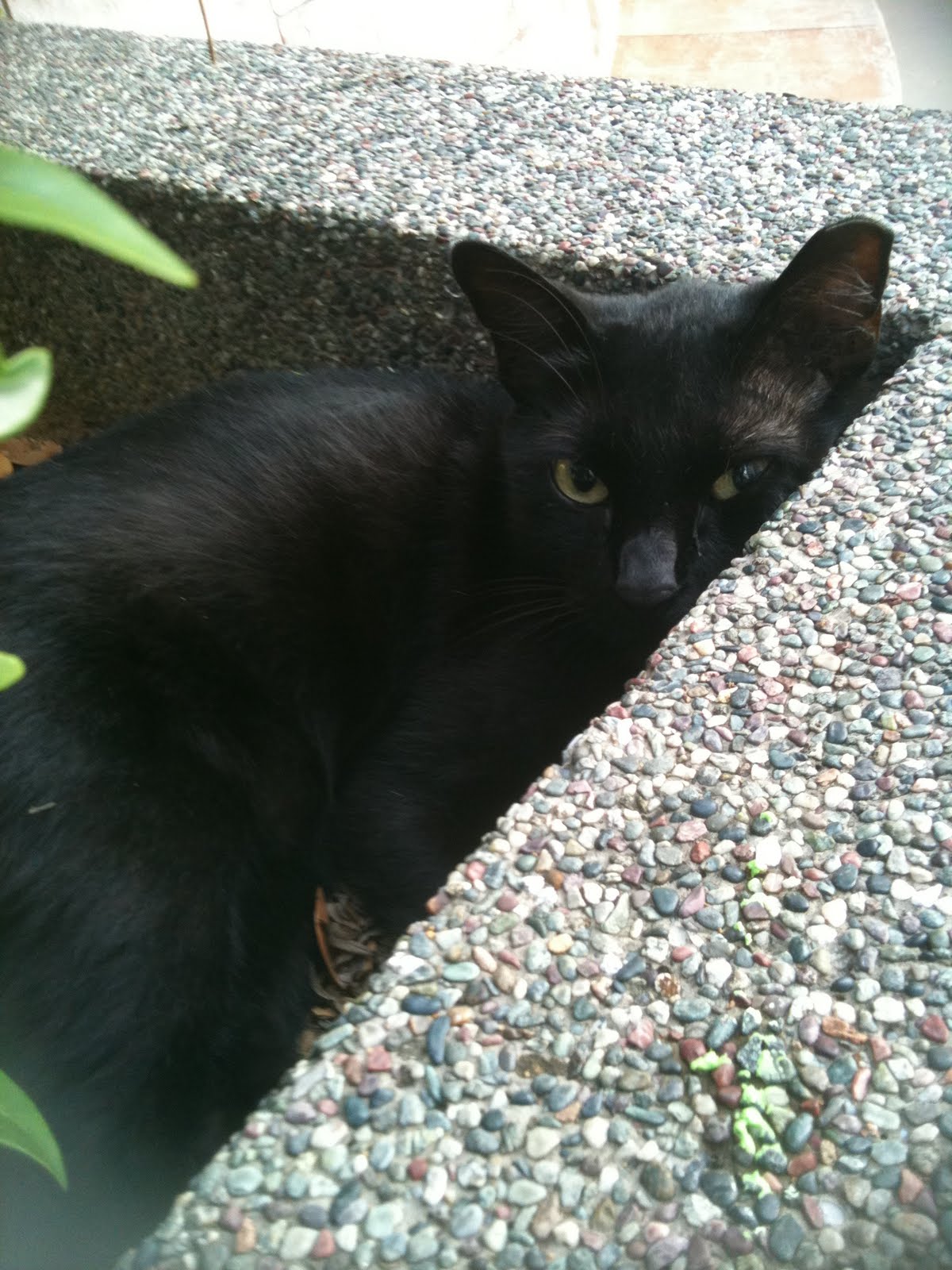
The cat that was complaint against for simply being black, took her last breath at 1.52pm on 16th September 2012, very peacefully.
She is estimated to be about 8 or 9 years' old.
She would have died in the drain somewhere, alone and fearful, if not noticed to be unwell by a caregiver who then asked for help.
Showing posts with label Firsie. Show all posts
Monday, September 17, 2012
Wednesday, September 12, 2012
Wednesday, July 4, 2012
Wednesday, December 29, 2010
Beautiful Firsie

A "harmless" cat cared for by some residents who got her neutered and provide food for yet. Yet a resident emailed to the town council to complain of the "presence of a black cat"!
She yearns to be "sayang".
She didn't ask to be born a cat, to be abandoned and to be black!
Why can't we just live and let (others) live as well!?
Wednesday, September 22, 2010
Thursday, September 16, 2010
Sunday, June 20, 2010
Firsie is still safe and sound
This is the community cat that, a few weeks ago, a kid was seen chasing to shoot with a rubber-band gun!
Thursday, June 3, 2010
Friday, May 14, 2010
Tolerate this but not that!
Thursday, May 13, 2010
"I am afrad this cat will hurt my grandson!"
6.50am. Seems like it is Firsie's routine to hang around at a particular section of the covered walkway, conditioned by regular feeding at this time. I called her and she tried to cross the walkway but nervously as it was a "peak period". Then I saw a Chinese woman in her 60s, accompanied with a younger woman in her 30s and a school kid aged about 10 who were about a metre ahead, making kicking gestures at Firsie who was croaching in fear.
I asked the woman what she was doing. She said she was trying to stop the cat from harming her grandson. I told that the cat seemed more afraid of her grandson. The woman's hurt pride might just prompt her to create a story of the cat's viciousness that may result in direct harm to the cat or through a complaint with the town council.
Feeders should also exercise wisdom in feeding cats:- DO NOT FEED THE CATS IN HEAVY HUMAN TRAFFIC AREA! All it takes is JUST ONE person to complain and the cats will be "dead meat" at the AVA!
10.30am

I asked the woman what she was doing. She said she was trying to stop the cat from harming her grandson. I told that the cat seemed more afraid of her grandson. The woman's hurt pride might just prompt her to create a story of the cat's viciousness that may result in direct harm to the cat or through a complaint with the town council.
Feeders should also exercise wisdom in feeding cats:- DO NOT FEED THE CATS IN HEAVY HUMAN TRAFFIC AREA! All it takes is JUST ONE person to complain and the cats will be "dead meat" at the AVA!
10.30am

Wednesday, May 12, 2010
Tuesday, May 11, 2010
"This is OUR cat as it came from GOD" said a child
11-05-2010 at 6.50am
Two kids stopped to "sayang" a community cat called Firsie as she was the "first" cat when caregivers started "cat management" in this neighbourhood about 6 years ago.
Wednesday, March 31, 2010
Long time no see, Firsie
This black cat was one of the FIRST cats to be trapped for neutering when two residents in this precinct decided to self-volunteer in applying TnRm to manage the community cats.
Friday, December 12, 2008
Prejudice against black cats merely on the basis of their colour!
A resident called up the town council to complain of the presence of this cat on the basis on her colour - "Ek...a black cat!"
December 6, 2008
For many dogs awaiting adoption, the speed with which they find a home may rest not on their breed, gender or age but on one trait that has no bearing on their personality or temperament.
Shelter officials have dubbed it black dog syndrome -- the propensity of dark-coated animals to be passed over for adoption in favor of their lighter counterparts.
Skeptics say the syndrome is an urban legend, but shelter and rescue leaders insist the phenomenon is very, very real.
"It definitely exists," said Madeline Bernstein, president of the Society for the Prevention of Cruelty to Animals Los Angeles. She cited many causes, not the least of which is a misperception that black dogs are mean. "It's that old thing of light is good and dark is evil. The light-versus-dark thing is so ingrained in our consciousness in books and movies. It transfers subliminally in picking out a dog."
It doesn't help that many would-be pet owners now start their search on shelter and rescue websites, where animals' back stories are often written up like the treatment for some Lifetime heart-tugger, each bio accompanied with a canine glamour shot. The problem: Black dogs often don't photograph well. Facial features disappear, and animals can appear less expressive.
"You can't see their eyes very well, and people seem to connect with the eyes," said Ricky Whitman, spokeswoman for Pasadena Humane Society & SPCA.
When prospective adopters do venture to a shelter, black dogs sometimes fade away into the kennel shadows. "They almost become invisible," Bernstein said.
Reliable quantitative studies on the problem are few, and Ed Boks, general manager of the Los Angeles Animal Services department, said his data indicate black dog syndrome is a myth.
In the last 12 months, he said, 27% of the 30,046 dogs taken in by his department were predominantly or all black. Of those that were adopted, 28% were predominantly or all black, he said.
Whitman said the question isn't whether a black dog will get adopted, but how long it will take. The average wait at her shelter is two weeks, she said. Black dogs may linger two months.
Karen Terpstra, who until recently was executive director of the Humane Society of Kent County in Michigan, said the problem is national. "We'd have a purebred black Lab, 2 or 3 years old, pretty much the perfect age, and it would sit there for weeks waiting to get adopted," said Terpstra, now chief operations officer for SPCA Cincinnati. "A tan Lab would go in days."
The lengthened stays create additional problems: Because black dogs are harder to place in homes, shelters often have a glut. "Then you have the problem of people thinking they're ordinary and common, not unusual and interesting," Bernstein said.
To combat the problem, savvy shelters keep their black dogs in their best-lighted kennels. A bright bandanna around the neck helps a dark animal stand out, and colorful toys can lessen the fear factor.
Last year Terpstra's former shelter in Michigan and the Austin Humane Society in Texas independently launched a Black Friday campaign on the day after Thanksgiving, reducing the adoption fee for any black animal. Mike Arms, president of the nonprofit Helen Woodward Animal Center in Rancho Santa Fe, created a program to help black cats, which he said encounter the same challenges as black dogs. Arms' campaign offers a free dark-haired feline with the adoption of any other cat. The program's name: Me and My Shadow.
The Pasadena shelter goes a step further, training dogs to venture from the depths of the kennels to come sit in front as visitors walk by. "People are charmed," Whitman said, and the dogs have a better chance of making a connection. And when all else fails, Bernstein said, SPCA-LA staff encourages adults to bring their children to shelters. "Sometimes," she said, "kids don't see color the way grown-ups do."
![]()
![]()
![]()
Read Black dog bias?
Liz O. Balen / Los Angeles Times
Some shelters say black dogs such as Jelly Bean are less likely or take longer to be adopted than light-colored ones.
Shelter officials disagree on whether dark-colored pets are passed up for lighter-hued ones. Some shelters make darker canines more appealing to counter any misperceptions.
By Craig NakanoDecember 6, 2008
For many dogs awaiting adoption, the speed with which they find a home may rest not on their breed, gender or age but on one trait that has no bearing on their personality or temperament.
Shelter officials have dubbed it black dog syndrome -- the propensity of dark-coated animals to be passed over for adoption in favor of their lighter counterparts.
Skeptics say the syndrome is an urban legend, but shelter and rescue leaders insist the phenomenon is very, very real.
"It definitely exists," said Madeline Bernstein, president of the Society for the Prevention of Cruelty to Animals Los Angeles. She cited many causes, not the least of which is a misperception that black dogs are mean. "It's that old thing of light is good and dark is evil. The light-versus-dark thing is so ingrained in our consciousness in books and movies. It transfers subliminally in picking out a dog."
It doesn't help that many would-be pet owners now start their search on shelter and rescue websites, where animals' back stories are often written up like the treatment for some Lifetime heart-tugger, each bio accompanied with a canine glamour shot. The problem: Black dogs often don't photograph well. Facial features disappear, and animals can appear less expressive.
"You can't see their eyes very well, and people seem to connect with the eyes," said Ricky Whitman, spokeswoman for Pasadena Humane Society & SPCA.
When prospective adopters do venture to a shelter, black dogs sometimes fade away into the kennel shadows. "They almost become invisible," Bernstein said.
Reliable quantitative studies on the problem are few, and Ed Boks, general manager of the Los Angeles Animal Services department, said his data indicate black dog syndrome is a myth.
In the last 12 months, he said, 27% of the 30,046 dogs taken in by his department were predominantly or all black. Of those that were adopted, 28% were predominantly or all black, he said.
Whitman said the question isn't whether a black dog will get adopted, but how long it will take. The average wait at her shelter is two weeks, she said. Black dogs may linger two months.
Karen Terpstra, who until recently was executive director of the Humane Society of Kent County in Michigan, said the problem is national. "We'd have a purebred black Lab, 2 or 3 years old, pretty much the perfect age, and it would sit there for weeks waiting to get adopted," said Terpstra, now chief operations officer for SPCA Cincinnati. "A tan Lab would go in days."
The lengthened stays create additional problems: Because black dogs are harder to place in homes, shelters often have a glut. "Then you have the problem of people thinking they're ordinary and common, not unusual and interesting," Bernstein said.
To combat the problem, savvy shelters keep their black dogs in their best-lighted kennels. A bright bandanna around the neck helps a dark animal stand out, and colorful toys can lessen the fear factor.
Last year Terpstra's former shelter in Michigan and the Austin Humane Society in Texas independently launched a Black Friday campaign on the day after Thanksgiving, reducing the adoption fee for any black animal. Mike Arms, president of the nonprofit Helen Woodward Animal Center in Rancho Santa Fe, created a program to help black cats, which he said encounter the same challenges as black dogs. Arms' campaign offers a free dark-haired feline with the adoption of any other cat. The program's name: Me and My Shadow.
The Pasadena shelter goes a step further, training dogs to venture from the depths of the kennels to come sit in front as visitors walk by. "People are charmed," Whitman said, and the dogs have a better chance of making a connection. And when all else fails, Bernstein said, SPCA-LA staff encourages adults to bring their children to shelters. "Sometimes," she said, "kids don't see color the way grown-ups do."
Wednesday, October 8, 2008
A resident complaint of the presence of a black cat
![]()
A resident complaint to the town council about the presence of this black cat. Fortunately the senior property officer was brave and reasonable enough to ignore the complainant.
Some other property officers would ask the pest controller to remove the cat to be killed at the AVA!
How many innocent feline lives have been lost because no one spoke for them.
Please call up the town council and speak to your property officer. Tell him or her that you will help to look into any feedback about community cats. This will prevent property officer from being lazy by only expending energy to pick up the phone to call the pest controller!
![]()
Subscribe to:
Posts (Atom)


Some time ago, the SPO told me that a lady resident complaint to him of the presence of a black cat (Firsie is the only black cat in this precinct). Fortunately there are caregivers here to speak up for the cats and the SPO is brave enough to brush off this silly "complaint"!