

Showing posts with label ACRES. Show all posts
Showing posts with label ACRES. Show all posts
Sunday, November 25, 2012
Friday, October 21, 2011
Swim at RWS or in the ocean?


http://www.todayonline.com/Voices/EDC111021-0000128/Swim-at-RWS-or-in-the-ocean
Swim at RWS or in the ocean?
04:46 AM Oct 21, 2011
I REFER to the letter "We should support RWS' Marine Life Park" (Oct 18), whose main theme was about "choice" and which suggested that, if given a choice, Singaporeans would choose a small but safe flat instead of a large country estate.
The reality for the Resorts World Sentosa dolphins is that they had no choice. They were removed from their natural habitat and will be confined against their will.
They have lost control over their lives, from what and when they eat to whom they socialise with and where.
The Animal Concerns Research & Education Society doubts that any Singaporean would want the lives these dolphins are now living.
Captive dolphins, in general, are not "choosing" to interact with humans during contact sessions or to perform certain behaviours on demand but instead are often doing so to get fed.
Yes, they could choose to go hungry, but most animals will avoid hunger at all costs, and a hungry dolphin will do just about anything for a fish, even a dead, frozen one.
While it is true that wild dolphins may not enjoy a carefree life, they do enjoy freedom and choice.
With regard to conservation, we agree it is vital, but we cannot agree that catching dolphins from the wild is supporting these efforts.
According to the World Conservation Union (IUCN), the threats facing Indo-Pacific bottlenose dolphins (the species purchased by RWS) include live capture for oceanariums.
The Convention on International Trade in Endangered Species of Wild Fauna and Flora (CITES) does allow the capture of dolphins from the wild.
However, according to the IUCN, catching more dolphins such as the Indo-Pacific bottlenose dolphin, which is preferred as a captive, display species, "makes them vulnerable to depletion from such catches".
The IUCN states that exports of this species should not take place from the Solomon Islands and that "CITES parties should not issue permits to import dolphins" from these islands.
How then can RWS claim to be protecting these dolphins while contributing to one of their threats to survival in the Solomon Islands?
Over 680,000 people have joined ACRES to urge RWS to release the dolphins. Our challenge to RWS is simple, and it leaves the decision to the dolphins.
If it believes that its remaining 25 dolphins are happy in their current situation, then ACRES asks that RWS gives the dolphins a chance to swim freely again in the ocean.
If they truly wish to remain living with their trainers and in captivity, then surely they will not swim away but remain with the trainers. Will RWS agree to this challenge?
The reality for the Resorts World Sentosa dolphins is that they had no choice. They were removed from their natural habitat and will be confined against their will.
They have lost control over their lives, from what and when they eat to whom they socialise with and where.
The Animal Concerns Research & Education Society doubts that any Singaporean would want the lives these dolphins are now living.
Captive dolphins, in general, are not "choosing" to interact with humans during contact sessions or to perform certain behaviours on demand but instead are often doing so to get fed.
Yes, they could choose to go hungry, but most animals will avoid hunger at all costs, and a hungry dolphin will do just about anything for a fish, even a dead, frozen one.
While it is true that wild dolphins may not enjoy a carefree life, they do enjoy freedom and choice.
With regard to conservation, we agree it is vital, but we cannot agree that catching dolphins from the wild is supporting these efforts.
According to the World Conservation Union (IUCN), the threats facing Indo-Pacific bottlenose dolphins (the species purchased by RWS) include live capture for oceanariums.
The Convention on International Trade in Endangered Species of Wild Fauna and Flora (CITES) does allow the capture of dolphins from the wild.
However, according to the IUCN, catching more dolphins such as the Indo-Pacific bottlenose dolphin, which is preferred as a captive, display species, "makes them vulnerable to depletion from such catches".
The IUCN states that exports of this species should not take place from the Solomon Islands and that "CITES parties should not issue permits to import dolphins" from these islands.
How then can RWS claim to be protecting these dolphins while contributing to one of their threats to survival in the Solomon Islands?
Over 680,000 people have joined ACRES to urge RWS to release the dolphins. Our challenge to RWS is simple, and it leaves the decision to the dolphins.
If it believes that its remaining 25 dolphins are happy in their current situation, then ACRES asks that RWS gives the dolphins a chance to swim freely again in the ocean.
If they truly wish to remain living with their trainers and in captivity, then surely they will not swim away but remain with the trainers. Will RWS agree to this challenge?


Sunday, May 29, 2011
Save the World's Saddest Dolphins

http://www.saddestdolphins.com/
http://theonlinecitizen.com/2011/05/the-dolphin-project-makes-proposal-to-rws-over-dolphins/

Singaporeans and the Animal Concerns Research and Education Society (ACRES) are also calling on RWS to free the dolphins. (Visit ACRES Facebook page for more.)
Support the campaign “Save the World’s Saddest Dolphins”.
May 28, 2011
Mr. Tan Hee Teck, CEO
Resorts World Sentosa
Cc Ms Aw Kah Peng, CEO
Singapore Tourism Board
Dear Mr. Tan:
I am contacting you on behalf of the Dolphin Project of Earth Island Institute. Our organization is working to protect dolphins around the world and prevent dolphins from being removed from the wild for captivity.
We know that Resorts World Sentosa has dolphins now being kept in the Philippines that were captured in the waters of the Solomon Islands.
We would like to offer the possibility of setting up a rehabilitation and release project for these dolphins in conjunction with Resorts World. Your cooperation would ensure that these dolphins be returned to their natural habitat where they can thrive, as opposed to keeping them in captivity, separated from their original home range, their pod and their extensive social environment.
In helping return these dolphins, Resorts World would show the people of Singapore and the world that you are a true steward of the environment and a responsible company sensitive to the harm captivity inflicts on dolphins.
We have reached an arrangement with the villagers of the Solomon Islands for them to stop killing dolphins in exchange for funding from Earth Island to help develop alternative energy, clean water, and sustainable fishing. We believe that if the people of the Solomon Islands can end their 450-year-old hunts to help dolphins, Resorts World can too.
We know the people of Singapore love dolphins. Most Singaporeans would object to keeping dolphins in captivity if they knew the dangers to the dolphins and the horrific capture practices of the Solomon Islands and other dolphin capture countries.
Thank you for your consideration of our proposal.
Sincerely,
Richard O’Barry
Marine Mammal Specialist

Monday, May 23, 2011

Sunday, May 15, 2011
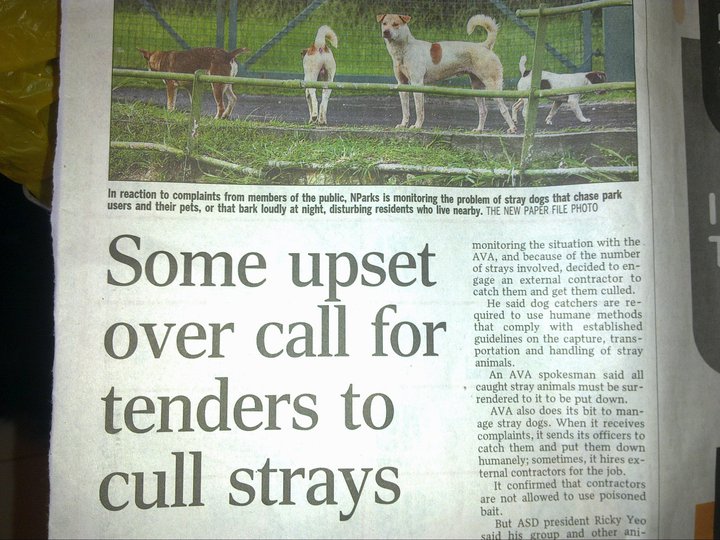
ACRES Forum Letter: Public should be consulted on tender to cull dogs
by ACRES: Animal Concerns Research and Education Society (Singapore) on Saturday, 14 May 2011 at 21:28
I refer to the article “Some upset over call for tenders to cull strays” (ST 14 May).
ACRES (Animal Concerns Research and Education Society) hopes that NParks can provide further clarifications regarding its decision to call for a tender to cull the dogs in the parks.
We share NParks concerns with regard to public safety, but is culling the dogs a long-term solution?
We understand that NParks decision was “in response to the more than 100 complaints it has received in the past year from members of the public”. Can NParks clarify how many people actually complained, as each person might have complained more than once?
We should also bear in mind that thousands of people have used the parks and have not complained and are concerned about the culling of the dogs. Any decision made should also consider the sentiments of this group of park users.
Lastly, can NParks clarify if it has consulted animal welfare groups like Action for Singapore Dogs or SPCA to find alternative solutions before it called for the tender?
As stated in the article, a more humane solution is possible and should be looked into as well.
Wednesday, April 20, 2011

Monday, March 28, 2011
Use sniffer dogs to nab animal smugglers

ST Forum
Home > ST Forum > Online Story
Mar 28, 2011
Use sniffer dogs to nab animal smugglers
IT IS disappointing to read that animal smuggling is on the increase in Singapore ("Animal smuggling on the rise"; March 21).
The illegal wildlife trade is exceedingly cruel and wasteful, and is now second only to the illegal trade in drugs and firearms. Reports have indicated that Singapore is ranked among the top 10 illegal wildlife smuggling hubs in the world.
While measures are in place to curb this trade in Singapore, there is, without a doubt, a need to do more and do so urgently.
In response to Animal Concerns Research and Education Society's (Acres) suggestion of using sniffer dogs to curb the trade, the Agri-Food and Veterinary Authority (AVA) stated that "they were less cost-effective than other measures".
Can AVA clarify what the other measures are and whether they are already in place?
Sniffer dogs have been used successfully in several countries. Thailand, for example, which is also a hub for the illegal wildlife trade, now has a sniffer-dog unit. The unit is largely designed to serve as a deterrent to would-be smugglers and wildlife traffickers. The training and maintenance of the entire sniffer-dog unit functions on a meagre annual budget of 1.4 million baht (S$58,000).
In South Korea, Animals Asia Foundation's (AAF) detective dog, Simba, worked with the Incheon Customs Department to spearhead the fight against the trade in endangered species. According to AAF, Simba worked in Incheon airport with his handler to literally "sniff out" smuggled bear gall bladders, bear bile products, tiger bone, ivory and deer musk.
In his two years of employment, Simba repeatedly detected major finds almost every month - totalling an astonishing 142 separate animal parts. These included over 80 finds of bear bile and deer musk, as well as whole bear gall bladders, snakes and seal penis.
Simba even found four live baby monkeys and 22kg of marijuana for which he was not even trained.
The use of sniffer dogs is not only cost-effective but is time-effective as well. Acres hopes that AVA will reconsider our proposal and we will be keen to collaborate with them on this project.
Louis Ng
Executive Director
Animal Concerns Research and Education Society (Acres)
Monday, July 12, 2010

Sunday, November 1, 2009
Acres can help with rescue of wild animals
01 November 2009
The Electric New Paper :
Acres can help with rescue of wild animals
I REFER to the picture captioned 'Coil Foil' showing a python captured in Kaki Bukit (The New Paper, 28 Oct).
Acres would like to draw attention to our 24-hour Wildlife Rescue Hotline - 97837782.
In cases where wild animals need to be moved or are found injured, Acres can be called upon to render assistance.
In addition, at our dedicated wildlife rescue facility, the Acres Wildlife Rescue Centre, we are able to take in rescued reptiles and amphibians in need of care.
More details are available on the website www.acres.org.sg
ANDREA KWAN
CAMPAIGNS OFFICER
ANIMAL CONCERNS RESEARCH AND EDUCATION SOCIETY (ACRES)
The Electric New Paper :
Acres can help with rescue of wild animals
I REFER to the picture captioned 'Coil Foil' showing a python captured in Kaki Bukit (The New Paper, 28 Oct).
Acres would like to draw attention to our 24-hour Wildlife Rescue Hotline - 97837782.
In cases where wild animals need to be moved or are found injured, Acres can be called upon to render assistance.
In addition, at our dedicated wildlife rescue facility, the Acres Wildlife Rescue Centre, we are able to take in rescued reptiles and amphibians in need of care.
More details are available on the website www.acres.org.sg
ANDREA KWAN
CAMPAIGNS OFFICER
ANIMAL CONCERNS RESEARCH AND EDUCATION SOCIETY (ACRES)
Subscribe to:
Posts (Atom)